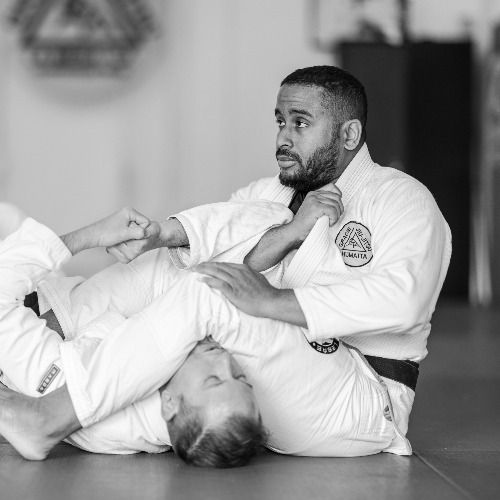
Episode 197
E197 | Celebrating Micro-Wins in Jiu-Jitsu: How Small Victories Prevent Burnout
About
In this episode of Tapped In, David Figueroa-Martinez explores the crucial habit of recognizing and celebrating "micro-wins" in Brazilian Jiu-Jitsu. The journey to black belt is a long, daunting marathon that often leads to burnout or plateauing—especially around blue and purple belt. David breaks down why small milestones, like hitting a sweep, successfully retaining guard, or simply showing up on a tough day, are essential for long-term consistency and personal growth. He also shares an instructor's perspective on student progress, the role of stripes, and why acknowledging incremental progress keeps grapplers grounded and motivated.
Key Takeaways
- Micro-Wins Prevent Burnout: Celebrating small daily improvements—such as escaping a position, avoiding a submission, or hitting a targeted guard—helps grapplers stay motivated across the decade-long journey to black belt.
- Instructors Want to Hear Your Progress: Coaches often miss individual breakthroughs on a crowded mat; sharing your small victories helps build momentum and allows your coach to acknowledge your growth.
- Track Time and Milestones: Tracking training longevity, consistency, and stripe promotions creates essential visual reference points to measure progress between major belt rank milestones.
Chapters
- 00:00 – Introduction: The Long Marathon of Jiu-Jitsu
- 01:00 – The Blue Belt Plateau & Burnout
- 02:18 – Why We Need to Celebrate Micro-Wins
- 02:35 – An Instructor's Perspective on Student Breakthroughs
- 03:40 – Belts, Stripes, and Droughts Between Celebrations
- 04:18 – Defining a Micro-Win: Small Victories Matter
- 05:13 – Learning to Acknowledge Personal Growth
- 06:03 – Realistic Wins vs. False Confidence
- 07:08 – Measuring Success Against Peers vs. Upper Belts
- 08:12 – Coaching Acknowledgment & Encouraging Consistency
- 09:12 – The Value of Tracking Time and Milestones
- 10:48 – Closing Thoughts & Contact Info
Are You You New To The Podcast? Start Here!
👉DFM Coaching Patreon Page
Everything here is pulled from real mats, real classes, and real conversations about what actually works. Choose the tier that fits where you are right now.
👉DFM Coaching In Person and Remote Coaching
DFM Coaching works with recreational grapplers who want to get better and actually feel it. Remote coaching and in person seminars available.
DFM Coaching Skool Community
Join the free DFM Coaching Skool Community, the space where the conversation continues after the episode ends. Mindset tools, mat culture, and a community of grapplers who take the mental side seriously.
👉 DFM Coaching | Bjj Skool Community.
Stay Connected
🌐 www.DFMCoachingBjj.com
DFM Coaching | Bjj Blog:
Long-form storytelling, deep strategy, and the philosophy behind the fight:
Affiliate Partner
BJJ Mental Models has one of the deepest conceptual Jiu-Jitsu libraries out there. I use it. I recommend it.
(Code: FIGUEROAMARTINEZ)
Help the Show Grow
If this episode gave you something, pass it on. Share it with a training partner, drop a review, or repost it to your story. That is how we keep the signal strong.
Stay tapped in,
David Figueroa-Martinez
Founder, DFM Coaching Bjj
Transcript
Full Transcript
00:00 | Welcome to Tapped In. My name is David Figueroa-Martinez of DFM Coaching, and today we're going to be discussing celebrating those micro-wins. Jiu-Jitsu is this long-ass marathon journey, and when you're there, you can easily get lost in the duration of everything and kind of just be dismayed or turned off eventually, or feel burned out because it is a long-ass journey.
00:36 | If you're not into role-playing games or massive world games and you're not accustomed to the fact that you're going to have to put in quite a bit of time to get to whatever you want to get to, you can get lost. You can feel like, "Why am I still doing this? Should I continue to do this?" especially when injuries may mount up, or the price of it might mount up, or just the fact that you reach one goal and in that goal you realize, "I did all this work, it took me, let's say, two years to get to this belt—blue belt—two and a half, maybe even three." Some of you it'll be a year.
01:23 | And I get to this spot, I worked my ass off, and you look up and you have X amount more that you have to go through and climb through, and these peaks to get to for purple, brown, and finally black—and then even at black, then you got the degrees and there's a whole host of things that come with getting your black belt. It can be very daunting. It can be very discouraging because you start thinking about everything that you went through to get to that specific belt, and if part of you says, "I don't want to continue to do this. Is it worth it? Is it worth my time, my sacrifice? What's it for?"
02:11 | And you can feel yourself kind of slipping, especially at blue belt, and decide that you don't want to do this anymore. I've seen people quit at purple and brown; I've seen people quit at black. So it's very easy to get into these positions where things just—it's too daunting, it's too much of a workload, too much to ask for.
02:35 | And I think that part of it is that there's only five belts. Each belt, for the most part, will take you a number of years, and on average people are taking 10, 12, 13 years to get to black belt. You have to be of a certain mindset to go through that regardless of everything else that's going on in your life, on and off the mat.
03:00 | One of the things that I think we should start doing more of is celebrating those micro-wins—the little things that we notice we're doing better. We hit the sweep, and we quietly celebrate with ourselves and we don't really say anything to anybody. As an instructor, I want to hear it. I want to hear when you're, "Hey, I'm doing better here," because I may have missed it. I have a whole class to observe and to watch over, and sometimes I'm looking one direction and you may have hit this sweep and I completely missed it, and you're looking over, "Oh, he didn't see it." Natural—there's so much shit going on.
03:40 | So in this endeavor that's going to take us a long time to get, and we sometimes get into this idea that it's black belt or bust—it's really not. Once you get here, I'm telling you right now, you kind of miss the struggle, you miss the come-up. And I'm not saying I don't have my own struggles, because definitely I do, but you miss being able to get excited when promotions came around—excited for yourself. It doesn't exist anymore. Now it's just time; I just don't have to die. Don't die and you get another stripe.
04:18 | But at that point, it was really specific to the things that you were doing, and there's an excitement to that. And if we only relegate it to those belts, it's a long desert, it's a drought between celebrations. Some schools do stripes, which I think—I personally encourage and I love doing. The stripes become those mile markers, and they become those moments where you get to be acknowledged for something that you're doing that maybe you don't even realize that you're improving on because you're stuck in the grind.
04:54 | So that's why it's so important to celebrate these little, little things. I don't care how small the win is. They submitted you one less time during the round. You were able to half-escape. You were able to formulate a guard when normally everything just falls apart. Celebrate those small micro-wins because that's what you start building on, and that's what you start building the confidence on, and you start looking at yourself a little different. And it's huge.
05:32 | I think for so long my issue was coming up, I didn't celebrate a whole lot of these wins at all. I would tell myself, "Hey, I'm going to celebrate this belt: go to dinner, go hang out with some friends, or whatever. I'm going to celebrate it." And then time would pass, and then I wouldn't do anything—like I didn't do anything for my black belt, which is weird. Like, I should have. And then it turns into, time passes, and you're just like, "Ah, what's the point now?" And then you just continue to grind.
06:03 | But the grind sometimes isn't what's going to necessarily keep you. I'm one of those people that I need to do better about that, but I don't want other people to fall into the same mistakes that I did. And I really want, as an instructor, I love getting those messages of, "Hey, this thing finally started working for me. Hey, I'm having an easier time with this philosophy or this approach that you showed me. This person didn't crush my knee shield. This other person was able to pass my guard, but then I was able to reassess and get the guard back."
06:48 | I absolutely love those messages. I get them periodically—I don't get them as much as I wish I would—and the reason why I get excited for it is because I get excited for the student. I understand how difficult this whole road is; I've been through it just like you were. And I remember those moments where I had little aha moments or little light bulbs—and I still have them from time to time—where you're just like, nothing's working, nothing. And then you have that moment where you're able to get to the guard that you were trying so desperately to get to. Everything else may have fallen apart, but you got there.
07:31 | And now we start to build a little bit of a game based on some minor successes that we had. And they're all going to be super minor at times. Sometimes they're going to be so minor that you yourself may not even be aware of them, and sometimes I catch them. My goal is like, "Hey, great job; I noticed that you did such and such today." Sometimes those minor goals are just that you showed up, as weird as that sounds. Just the fact that you may not have wanted to get out of bed, you may not have wanted to get out and do another activity—maybe you're depressed, maybe you're having issues, maybe life is kicking your ass, and you made it to class. And I know that you're going through it, and I'm like, "Great job, love that you came in." It's a micro-win, and I'm going to celebrate it. I'm going to acknowledge it.
08:24 | So when I do that, I also want to see the students start doing that too. I want the students to start building that momentum, and it happens with getting into the habit of celebrating those things. You don't want to take every little thing as a thing to celebrate. There's times when sometimes I've had students who are celebrating something that I know wasn't necessarily realistic. I had a student who, "Hey, I beat this brown belt," and I'm like, "What?" "Yeah, I beat them; I did this, this, and this." I was like, "They're letting you play. Don't get confused." I think it was the way they approached me about it.
09:02 | And I said, "No, it was legitimate." I was like, "No, it wasn't. I'm telling you right now, I can't let you walk around with a false confidence in what happened because that's not what happened. They're letting you work, or they're working on something brand new, and you were able to succeed based on that. Great! I'm happy for you, but I don't want you to walk around with this bravado like, 'I did this, this, and this.'"
09:27 | Let's not confuse the micro-wins for the moments when people are kind of letting you work, and that work is a good thing. It allows you to experience some things, to work out of problems, to—I don't want to crush you. I don't want to destroy your whole game, but I also want you to understand when some things are a little bit more legitimate and when things are not.
09:51 | I remember when I subbed my first black belt. Looking back at it, it was not legitimate. It was not something to be necessarily happy about, but at the time it made me super ecstatic. But looking back, it was false; it wasn't necessarily the thing that I should have gravitated to. What I should have been gravitating more to was: how am I doing against my own peers? Your peers are not going to let you play. Your peers—the people that are side-by-side, neck-and-neck technique-wise and development-wise—they're going for you.
10:32 | The upper belts, sometimes we're going to let you work. Sometimes you legitimately fool us; sometimes you legitimately do some things that surprise us or get us in a bad position. I celebrate those moments too, and where they're super legitimate—like I got submitted in class by a lower belt—I've said this before: I genuinely, generally hand them my belt at the end of class in front of everyone, just before we bow out. And it's just a way of saying, "Great job; you did the thing you were supposed to do, you got me."
11:11 | And when I do that, it's legitimate. I'm not looking to placate or stroke your ego or anything. No, you did the things that you were supposed to do, and you caught me. Great—that's what I want. I want to celebrate those moments. I want people around to kind of notice those moments too, because we're all rolling, we don't see it all the time.
11:32 | So I will compliment people regularly when I notice that someone who's busy and has a busy schedule starts finding time: "I'm so happy to see you; I'm so glad that you're training." When I see someone who's been struggling with some things and I notice that you're a little more aggressive today: "Great job." When I see someone who's been working on a specific guard and maybe they're starting to hone in on the right tactics: "I noticed that you're getting that underhook, I noticed that you're off-balancing a little bit better—that was beautiful." It may not have ended the right way, but those are those micro-wins that we want to celebrate.
12:09 | And as the coach, I try to do this as much as possible, but we should be doing it within ourselves: "Hey, I got this." Not in a bragging way, but in a way of just kind of understanding that we're on the right path, we're moving towards the right direction, we're doing the things that we're supposed to be doing.
12:28 | I'm big on time. I have a terrible memory; I put everything into calendars. I put my anniversaries in calendars, when I got promoted at such-and-such job, when I got promoted at such-and-such belt, when I got my last degree—all that. I'm big on time. Time can help you evaluate the overall progress. Hey, I've been—I think this year I hit five years at black belt. That means I've been running the morning program for five years now. I'm pretty sure that's accurate. That's a huge plus for me, and I have to go off of those. To me, it's a micro-win; it's not a win that is based on, "Hey, I won the championships" or I got this or I got that, but it shows the commitment to the program and a commitment to me learning or getting better at teaching because I've invested this time. It deserves some acknowledgment.
13:38 | So for me, I see it and I might speak about it occasionally or bring it up on a blog or a podcast topic, but those are little wins for me that I have to attach myself to because, again, this is a long-ass journey. And if I don't make these little mile markers, I potentially can get lost in the entire process and kind of lose myself and why I'm doing it. So the mile markers help.
14:06 | Same is going to do for you guys. And then once you get to black belt, oh man, it's a whole another beast, whole another beast. You have zero belts to go to, especially if you're a certain age—like I'm 45, I'm never going to reach the next belt; I'm going to get maybe a couple of degrees, and who knows after that. But celebrate your mini milestones, your mini wins. Embrace them, make them factors in your life. You do not want to go through this entire time looking at only the big wins and then getting swayed because you can't get there fast enough.
ons, please hit me up at @dfm.: