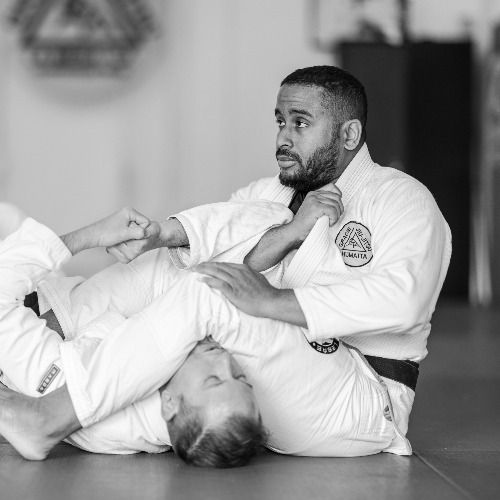
Episode 226
E226 | Calibrating Your Jiu-Jitsu Radar: Games Over White-Belt Panic
DFM Coaching Library:
https://www.patreon.com/cw/DFMCoachingBjj
About In this episode of Tapped In, David Figueroa-Martinez breaks down the concept of the "sensitive radar"—that early-stage phase where newer grapplers treat every grip, reach, and movement as an immediate disaster. Moving beyond the polarized debate between traditional drilling and the Constraints-Led Approach (CLA), David shares how coaches and students can integrate both methods. By blending foundational movement with high-percentage, objective-based mini-games, students learn to filter genuine danger from harmless distraction, calibrate their intensity, and explore their Jiu-Jitsu in a safe, curious environment.
Key Takeaways
- The "sensitive radar" is a normal phase: Early in the journey, grapplers lack the predictive intuition to separate genuine threats from harmless noise, leading to hesitation, panic grips, and overreacting.
- Constraint games calibrate threat awareness: Designing focused, low-variable scenarios—such as denying a cross-collar grip from bottom mount—channels attention directly into the most critical defenses and counters.
- Traditional drilling and CLA work best together: Rather than choosing one over the other, combining mechanical shape-building for newer practitioners with dynamic, exploratory games builds authentic skill retention and joyful learning.
Chapters
00:00 - The Sensitive Radar and Overreacting to Everything
01:05 - Giving Upper Belts Too Much Respect
01:46 - Calibrating Intuition Through Focused Scenarios
03:00 - Designing the Mount Escape & Cross-Collar Game
05:10 - Learning the Rules, Lowering the Panic
06:21 - Dealing with Outliers and Unorthodox Styles
07:18 - Being a Mat Scientist: Curiosity Over Outcome
08:24 - Bridging the Gap: CLA vs. Traditional Drilling
10:04 - Social Links and Outro
Are You You New To The Podcast? Start Here!
👉DFM Coaching Patreon Page
Everything here is pulled from real mats, real classes, and real conversations about what actually works. Choose the tier that fits where you are right now.
👉DFM Coaching In Person and Remote Coaching
DFM Coaching works with recreational grapplers who want to get better and actually feel it. Remote coaching and in person seminars available.
DFM Coaching Skool Community
Join the free DFM Coaching Skool Community, the space where the conversation continues after the episode ends. Mindset tools, mat culture, and a community of grapplers who take the mental side seriously.
👉 DFM Coaching | Bjj Skool Community.
Stay Connected
🌐 www.DFMCoachingBjj.com
DFM Coaching | Bjj Blog:
Long-form storytelling, deep strategy, and the philosophy behind the fight:
Affiliate Partner
BJJ Mental Models has one of the deepest conceptual Jiu-Jitsu libraries out there. I use it. I recommend it.
(Code: FIGUEROAMARTINEZ)
Help the Show Grow
If this episode gave you something, pass it on. Share it with a training partner, drop a review, or repost it to your story. That is how we keep the signal strong.
Stay tapped in,
David Figueroa-Martinez
Founder, DFM Coaching Bjj
Mentioned in this episode:
Patreon Blueprint Ad
Transcript
Full Transcript
Welcome to Tapped In, my name is David Figueroa-Martinez of DFM Coaching, and today we're going to be discussing the sensitive radar. I was recently discussing building up intuition, and I made a couple of posts about it, and it was a topic of discussion in one in a blog that I put together. And someone asked me, so how do you tweak that sensitive radar? When you've read—when you've been training a while, what happens is your body can diagnose what's most readily harmful and what is just noise. When you are, let's say first year, first six months, if you've ever rolled with someone in that time period, you will notice that they respond to everything. They are hesitant to enter your guard, they're hesitant to make any grips, they're hesitant to—to—to commit to anything, any decisions they make. And so much of is it is kind of—kind of really like jittery, I think is the—the right word. And I have a couple of students in mind that they're on the newer side, and this is just part of the—the process, and I'm not mocking them or—or making fun of them at all. We were all there at one point.
MP3
+ 4
And what happens is because everything—everything is on the more newer side, and you're going against someone who's maybe more advanced, like when they go with me, I think, and I was guilty of this at one point, we give too much respect to the upper belt, and we think that everything is a trap. Don't get me wrong, I set up a lot of traps, and I amuse myself quite a bit, but it's not necessarily what I'm doing, it's more about what they're doing. So what happens is they'll grab maybe your pants, or they're—they're trying to get into the guard, or not get into, but trying to address the guard, they'll grab your pants and they'll let go. Or their hands will shoot forward, and then they'll stop halfway. They'll get a grip, and then sort of like it, and start to move, and then let go of it as soon as you start to maybe counter. Sometimes you just got to get a hold of something and make a decision.
MP3
+ 4
But early on, if we can picture like a radar system, and it's just going off in every possible movement, every possible threat, and it doesn't understand what's genuine and what's just noise, that is what's going on in them from what I can see on the outside. Cultivating more understanding of what's a genuine threat will happen with class and mat time and time spent rolling. But in order to kind of make that little faster or shorter learning curve, one of the things that we can do is set up these games with very specific things in mind. When I play or when I set up my—my classes, I will often have a—a point, a warm-up, a section where I am giving a technique, they drill, and then often times we will do games based on what we were doing. And my goal being, I don't want them to enter the games without knowing any possibilities, because in my opinion it's a little bit of a waste, but I also don't want them to—to relate or to rely on dead drilling too much. But I need them to build up the muscle memory and to remember where the hands can go.
MP3
+ 4
When I teach, I don't necessarily want people to feel like these are laws: "Oh yeah, I have to do this or have to do that." There's a lot of variables in everything that we do, and there's a lot of different ways to get a pass, and a lot of different ways to choke people out and get arms. I am only showing possibilities. And I try to frame it that way so that people don't get stuck in, this is the law of this position. Because even my own passing, for example, has changed over the last two years. I used to have a very specific, rigid approach, and now it's a little bit more—it's a lot more fluid, really. So, what I'll do, like let's say we are—we're reviewing mount escape. In the—in the the dead drilling, if that's what we want to call it, traditional drilling, I'll discuss the position, I'll discuss things that I need to be aware of from—from the bottom position, where my hands are placed. I have a preference for where my hands go. I do not like them at my collar, both of them; I use one at the collar and one at the hip.
MP3
+ 4
I will discuss, in stages, what I'm looking to do. So, I might have in the drill, top person, I want you to get cross-collar. And then when the cross-collar happens, or maybe before it, this is what I want bottom player to do. So then I make them drill bridging so that the collar never gets grabbed. And it's that segment between when the top person decided to do it and when they try to do it, we're going to bridge, make the hands busy. Then the next: okay, so they got in, we're going to get this grip, this grip, we're going to do this with our feet, we're going to bridge and we're going to roll them over. And then I go over potentially a third option: what if they grab and control the head? And we repeat that process for the head, because in essence it's the same thing.
MP3
+ 4
And then when we do the games, I will put the bottom person in place, and it's like, your job is to never let him control your collar. Top person, if you can get the collar for let's say three seconds, hypothetically, and maintain the position, you win, we start all over. So what now I'm doing is I am calibrating them to understand one of the most important and most imperative things for them is to understand that they cannot get or allow a cross-collar grip, because then it sets up other things. So, before they get the grip, I want you to bridge—be bridging. I want you to understand how important that bridge is. So now I've solidified the game to have one threat, not a million—and I'm being facetious, but not a ton—it's one threat, a very high-probable threat in most rounds.
MP3
+ 4
And then we give—there's an answer there, and it's them building up the—the—the tempo of when to bridge, how to bridge. And then, in the next iteration, maybe we start with the hand in the collar. Now, top person, your job is the cross-collar choke, very high percentage from there. Bottom person, your job is to get rid of that grip or reverse the position; you cannot allow them to cross-collar choke you. So now we're, again, we're simplifying all the viable threats to what's most high percentage, allowing them to work and get high mileage inside of a game with very specific parameters. The radar does not have to go haywire trying to figure out everything at once. It's very specific. They understand the rules of the game; top person knows what their winning parameters are, bottom knows what theirs are, and we can focus on specific things. And you can widen that game however.
MP3
+ 4
Eventually, it's going to be top person gets to submit, bottom person needs to escape or reverse the position. And because you've done iterations of the game with the possible, most likely threats, they're now adjusting their sensitivity on the radar. They're not worried about everything; they're worried about very high-percentage, two-to-three possibilities. And then they're also learning how to create space, how to get their guard back in, how to reverse the position. And that's a great way of really addressing that sensitive radar so they can also play in that—in that space, opposed to, hey, just go roll. Go rolling does—does doesn't help; there's way too many variables in every position, and from start to finish that everything is a threat. When you can simplify and give them specific direction in that game after giving them options, it goes a long way, goes a super long way.
MP3
+ 4
So these games are going to be really useful, and it's important for you to kind of use them in a way that lets people understand that they can be customized. I have positions that I'm not great at; this is where these games can kind of really help me in those spots where I get more comfortable just even being in the position, versus even worrying about all the other things that come from that position. You get to understand, hey, I can go—I can go hard here, I can go very specific here, I can dial it back. We can go, hey, let's go 50–60%, and not like the 50–60% like that white belts give you, but like a genuine 50 or 60%, and then have a dialogue about it. You can work with the other person, be like, hey, I noticed you keep doing this, this, and this, you need to really do this instead, and you can correct in the middle of it, either as a coach watching or if you're the partner. If you're a higher belt and you—you're noticing things and tendencies and patterns, address them. Let them work and understand in the position.
MP3
+ 4
This allows people to now perceive threats differently. It's like if I'm walking—it's like if I'm having a meeting with my boss, and I can understand her language and I can understand what her goals are for a project, when I go to the meeting I understand what we're going to be discussing. Now, if she never tells me what we're discussing, my radar is going to be high; it's going to be really sensitive because I don't know what—I know it's something serious, but I don't know what it is. So, when I can understand the other person more, and that's correlated to these positions, because we're spending so much time in the positions with the games, we understand what's likely, we understand what's not likely. Not that there are not variants in this, because some people have wonky games, they have weird approaches, they have different things that they focus on, and sometimes you just get hit with some weird shit and at the end of the day you're like, I don't know where that came from. It happens all the time.
MP3
+ 4
I had a student who did bread cutter from bottom; he would do that shit often. I have another student that has this weird roll: he'll grab your belt from bottom and then wait—wait for you to cut a certain angle and then he rolls you. Those are things that don't happen with most people, so they're always going to be outliers, but really spending that time in these positions is going to create a little bit of a deeper understanding. You get used to what's most high percentage, like I said, and you just get to play inside of the games. You have to—you have to get the students to also understand that the winners and losers do not matter. We're not building—we're not gaining stripes by playing these games; I want them to just explore. And I say that quite often when I'm teaching classes and it's specific and we start cracking these games open.
MP3
+ 4
One of the things that I'll often say is, I want you to be little scientists and just explore shit. If you try something, you fuck up, and you get submitted, who cares? Doesn't matter to me; I don't want it to matter to you either. I want you to be curious, and let that curiosity feed into the things that you're doing, and I want you to pay attention to what you're doing so when you have questions you can ask me a thoughtful question of the details that you're encountering, opposed to very broad question about something that you didn't quite understand. I think this is going to make huge difference for people. And I understand there's a big debate still raging about CLA versus traditional. I don't think it's a versus thing, I think it's both: apply both where needed. If we're talking purple belts and up, we probably need less drilling, which is understandable. By that point, you understand the mechanics of things, unless we're doing something completely different or new, you understand the basic mechanics of Jiu-Jitsu, so you can play more games than normal.
MP3
+ 4
If we're talking newer, white, blue belts, and we're talking about things that they don't have the muscle memory for and the complexity of how the body moves, we're going to have to do some drilling. And then once we get at least an understanding of that, then we can play all the games we want. And that's perfectly fine, and it works out—for me, it works out really well. It's not a choice of one or the other. Our jobs are to make learning fun for you, and make learning accessible and enjoyable with minimal injury. And if these games are going to lessen that learning curve while you're having fun and enjoying yourself and laughing and maybe making some comments with your training partner during the games, beautiful. It's one of the things I love. I love being in a class and I'm hearing laughter, and I'm hearing the—the joyous voice—voices and the words and, "Oh shit, you almost got me," or you did, or someone did something stupid and they're both laughing. That's where the learning happens.
MP3
+ 4
g else, please hit me up: dfm.: