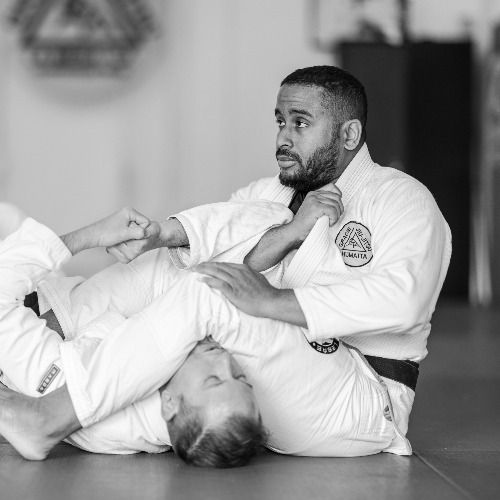
Episode 229
E229 | How to Be the Right Training Partner for Competition Prep
DFM Coaching Library:
https://www.patreon.com/cw/DFMCoachingBjj
About
In this episode of Tapped In, I discuss what it really takes to be the training partner your teammate needs when they’re gearing up for a tournament. Inspired by a prompt from Tinley (@tinleykindy) on Instagram, I break down why helping a competitor requires adopting a service-first mindset rather than rolling for your own ego. I share lessons from my time coming up as a white belt under Will Baldwin, explain how your intensity must shift from pushing someone to their physical limits four weeks out to protecting their health and sharpening their game two weeks out, and look at how to help teammates navigate the mental battles when their cardio and adrenaline start to slip.
3 Key Takeaways
- Adopt a Service-First Mindset: When rolling with someone in camp, your objective is not self-validation or hunting submissions; your priority is exposing the holes in their defense, testing their weak positions, and serving their specific preparation.
- Shift Intensity by Timeline: Four weeks out calls for maximum pressure, challenging positions, and tough situational rounds; two weeks out requires dialing the pace back to preserve health, refine timing, and maintain momentum.
- Prepare the Mind for the Wall: Competition creates adrenaline dumps and moments of panic where cardio slips; training partners need to expose competitors to deep exhaustion in the gym so they learn to regulate their breathing and trust their recovery.
Chapters
- 0:00 – Introduction & Tinley's Question
- 1:13 – Adapting to the Timeline of Competition Prep
- 1:38 – Lessons from White Belt: Prepping with Will Baldwin
- 2:44 – Being of Service: Leaving Ego Off the Mats
- 3:38 – Diagnosing Weaknesses & Steering the Action
- 5:14 – The Emotional Weight of Training Camps
- 6:44 – Four Weeks Out: Imposing Reality & Simulating Pressure
- 8:14 – Pushing the Mental Wall: Breathing Through Panic
- 10:52 – Simulating Match Speed Without Causing Injury
- 11:58 – Two Weeks Out: Dialing Back & Sharpening the Sword
- 13:00 – Building Unshakable Confidence for Competition Day
- 14:38 – Outro & Connecting with DFM Coaching
Are You You New To The Podcast? Start Here!
👉DFM Coaching Patreon Page
Everything here is pulled from real mats, real classes, and real conversations about what actually works. Choose the tier that fits where you are right now.
👉DFM Coaching In Person and Remote Coaching
DFM Coaching works with recreational grapplers who want to get better and actually feel it. Remote coaching and in person seminars available.
DFM Coaching Skool Community
Join the free DFM Coaching Skool Community, the space where the conversation continues after the episode ends. Mindset tools, mat culture, and a community of grapplers who take the mental side seriously.
👉 DFM Coaching | Bjj Skool Community.
Stay Connected
🌐 www.DFMCoachingBjj.com
DFM Coaching | Bjj Blog:
Long-form storytelling, deep strategy, and the philosophy behind the fight:
Affiliate Partner
BJJ Mental Models has one of the deepest conceptual Jiu-Jitsu libraries out there. I use it. I recommend it.
(Code: FIGUEROAMARTINEZ)
Help the Show Grow
If this episode gave you something, pass it on. Share it with a training partner, drop a review, or repost it to your story. That is how we keep the signal strong.
Stay tapped in,
David Figueroa-Martinez
Founder, DFM Coaching Bjj
Mentioned in this episode:
Patreon Blueprint Ad
Transcript
Full Transcript
**** Welcome to Tapped In. My name is David Figueroa-Martinez of DFM Coaching, and today we're going to be discussing being the right training partner for someone who is gearing up for a competition.
MP3
+ 1
**** I came across this post that I was tagged in by Tinley—T-I-N-L-E-Y K-I-N-D-Y on Instagram. She has become one of my favorite Instagram personalities or people within Jiu-Jitsu. She makes these great videos talking different discussions or topics. She does not hold back. She broaches topics that some people don't want to talk about. She is a fantastic follow. Please look her up, give her a follow; she has great content.
MP3
+ 4
**** One of the questions that she posed was: what level of training should you provide someone who's getting ready for competition? And she tagged a couple of us that were in the instructor or coaching fields for us to respond. And while I responded, and you can only respond so much on a comment, I decided, you know what, I'm going to do a topic on it because it is a fantastic question. And it's going to depend on what stage in the competition prep we're probably in.
MP3
+ 3
**** And this is coming from a hobbyist competitor who hasn't competed in a while, but was competing quite a bit at white, blue, a little bit at purple, and has not competed at black at all. So, take my advice with a grain of salt. Maybe you feel different, maybe things have changed, maybe your coach or your lineage, your gym, does things differently. By all means, do not subscribe to what I'm saying if you guys have something set that you are completely behind.
MP3
+ 3
**** My interpretation of being a good training partner really does depend on what stage of the competition prep we're in. I'm going to be very different if we're months out versus two weeks from the competition. So, those things are going to vary, they're going to change, they're going to be a little bit different.
MP3
+ 2
**** But I want to come in—so let's backtrack. When I was a white belt, I had a mentor who was a purple belt, Will Baldwin. I've probably spoken about him on some of these episodes. And I would see him getting prepared for competition, and I tried to be the best training partner the only way I knew how, which was training hard. And trying to show up as many times as he needed me, and doing what I could do.
MP3
+ 4
**** Again, I was a white belt at the time. I didn't have all the skills necessary, but his competition prep actually helped my competition prep when I started competing, and it helped me overall in how to approach Jiu-Jitsu, how to think about setting up traps, how to think about setting up a game and where it's going to go, and how I'm going to apply myself within the scope of what they're doing. So, being around him and seeing him prep and being part of that prep process was a big deal for me, and it was a huge level of improvement.
MP3
+ 2
**** But I could only give him so much. And as a white belt, I don't have the skill. So what I could give you was the intensity. So that's what I gave him. And there was probably days where he was like, "I need you to dial it back," I don't know.
MP3
+ 4
**** But overall, in general, if we're talking about everyone who's trying to help someone else compete, I'm looking at it as: first and foremost, you're of service. You're there to make sure they get what they need. I'm no longer in a process of—even though I'm going to give you quite a bit when it comes to intensity, especially for a month or more out—my goal isn't to make myself look good. It is not to make myself give myself a pat on the back because I was able to submit you five times today or five times this week or whatever. I really do have to come at it from a standpoint of: I'm of service to you and what you need.
MP3
+ 4
**** So you might tell me you need something different. You might tell me on early in the week, let's say we're training Monday, Wednesday, Friday, hypothetically. You might be perfectly okay with me amping it up Mondays and Wednesdays, and then by Friday you might feel banged up. And you might talk to me and be like, "Hey, let's just dial it down a little bit, let's more of a flowy round, more of a conversation." And I go with it, because we're listening to your body and you've already put in the work earlier in the week. Maybe you want to taper off at the end of the week because it's been a long week, you got to work, you got to whatever. Then I'm going to listen to it.
MP3
+ 4
**** I'm going to also, as being of service, pay attention to your game. I'm going to pay attention to the things you don't do well. And again, that's me as a black belt and a coach. I'm looking at your game fully: things you do really well, the things you could use a little bit of work on. So I'm going to steer the game or the rolls to the things that I think you should be working on.
MP3
+ 4
**** I'm going to steer things to the side that maybe you haven't repped for. I'm going to steer things to the areas of Jiu-Jitsu that you do not escape well from. Like maybe you don't do well from side control bottom. I'm going to steer the action a lot towards that position, because I understand that, hey, more than likely if we're on bottom, we'll probably see a side control. And if you can't escape, I haven't done my job as your training partner and/or your coach.
MP3
+ 4
**** So yes, I'm of service. I am not, when I roll with you specifically, looking to make myself better. I'm not looking to put myself above you and pat myself on the back and go away from that feeling like, "Oh yeah, I got them." That's not the goal. I might get all those same results, but the goal is: I need to make sure I'm making you better every time you get on the mats with me.
MP3
+ 4
**** And that's going to look different sometimes. It's going to look different from day to day. And training camps, I have been a part of them, I have been the focus of them, and I have watched people at lower belts, I've watched people at black belt get ready. And training camps can be really emotional.
MP3
+ 3
**** And there's going to be times when—I remember I was rolling with someone getting ready for a training camp, I can't remember if it was Worlds, and they had a hard time that day. And they got emotional, had to walk off the mat, take a minute. And I didn't, as a guy, that's not something that we necessarily do, but I didn't look at that person down, or I didn't judge them or think less of them. I've been around long enough to see, one, what competition does to you when you're there, because as someone that competed, and then I've seen plenty of training partners struggle through the course of a camp. Because there's days where you're on a real high and there's days that you're on a real low.
MP3
+ 4
**** And then your—if you're a woman you're going through your own hormones. If you're a guy or a woman, you're going through life, and something at work might have triggered something, something at home may have triggered something, something with your kid may have triggered something, and then you're having to carry that within the competition prep. So that process in a camp is emotional at times. But again, your job is to be whatever they need you to be.
MP3
+ 3
**** And there's going to be times when you might feel like, "Hey, today's a porrada day. Today we going hard." And you look up and they had to walk off the mats for some reason; they were struggling. You address, you assess, and when you're ready, you get back on the mat and you go back to porrada if they're up for it.
MP3
+ 3
**** It's a strange environment, and if you've never been part of a camp, if you've never competed, if you've never gotten ready, if you've never watched your training partners get ready, it's an interesting endeavor. But for me, again, my thought process is always: I'm of service.
MP3
+ 1
**** When it comes to the intensity of a training session, if we're a month or more out, I want to give you hell. And I know that sounds bad, and I know that sounds like, "Oh, why would we do that to a competitor?" We want to put them in as many different spots as possible where they, one, don't do well, they need to improve, and we want their body to betray them and we want their mind to betray them.
MP3
+ 2
**** And what I mean by that is, when I train with someone, it's very conversational. It's a back-and-forth. It's a little bit of a debate, so I might step on your words or step on the point you're trying to make. I might run into the things you want to do, I might prevent certain things from happening, but the flow of the round could still be deemed conversational. There's a back-and-forth. I'm never 100% just wrecked you in a general roll. You're going to have your moments, I'm going to have my moments. In these rolls, maybe I have most or more of the moments, which is fine, but there is a back-and-forth, conversational. And those rounds, we're both looking to learn things.
MP3
+ 4
**** In a competition prep round, I'm looking to push you to places that you're not quite used to. I want your body to be sore, I want your body to have to withstand the rigors of getting ready for a competition, what you're going to feel when you get there that day. They are not looking to have a conversation with you. They are not looking to give you any give whatsoever. They're not giving you any spaces whatsoever.
MP3
+ 4
**** Anything you get in a competition is legitimate, because of something you did really well or a huge blunder on their part that they weren't aware of. But they're not willingly giving you anything, the same way you shouldn't be willingly giving them anything. So those rounds at a competition are amped up quite a bit.
MP3
+ 2
**** I have to give you a simulation of those rounds in the lead-up. So I push a certain way: I push you hard, I will try to crush your guard, I will try to crush you from the top, I will try to crush you from every conceivable position that I end up getting. If you willingly give up a position, which we often do in conversational Jiu-Jitsu at the academy, I'm going to punish you for that.
MP3
+ 2
**** Because there is an unwritten rule when we roll where we're going to play Jiu-Jitsu and we're going to be very nice about it. In competition, they're trying to impose Jiu-Jitsu on you, and they're trying to impose their version of it on you. You can't accept sweeps, you can't accept transitions, you can't accept passes. So when I roll, where we're a month or more out, I'm punishing you for your mistakes.
MP3
+ 3
**** I'm dialing up the intensity so that you can feel what a collar drag is really going to feel like in competition. And I'm not trying to hurt you; safety is above all, don't get me wrong. But I need your body to feel what it's going to potentially feel like when you get on there, so it's not a shock to you.
MP3
+ 2
**** If we're rolling very conversationally and you never feel what it might feel like, and then you get out there and you slap hands and they grab you by the collar and yank you and you bust your face on the mat, and then they get on top of you and they are driving all of their weight with knee-on-belly and you don't know what the fuck you're doing, I failed you as a training partner and/or a coach. So I have to give you that intensity.
MP3
+ 1
**** The other part of this is: I'm going to set up situations, both with the intensity and with the ruleset, where maybe I stack the deck against you and we're doing shark tank. And it's eight minutes, and every minute you're getting a new person. Because now I need to attack your mental aspect, your resilience. And I need to put you in a position where your cardio starts to lose control and it starts to slip away.
MP3
+ 3
**** And there is—God, who was it, Cus D'Amato? I forgot how he worded it: exhaustion or lack of cardio makes cowards of all of us. Something around those lines; I'm getting it wrong, trust me, I am. But there is a moment when you're competing—and it happens sometimes in rolling too—but when you're competing, where the adrenaline spikes, and your control over your breathing and your cardio slips away. You will feel like you're dying.
MP3
+ 3
**** And I know I'm being a little much, but that is the best way that I can word it to someone who's never felt it. And I have students that will be competing for the first time, I have students who have competed for the first time, and what I try to tell them all leading up to it is: I want you to have fun, I want you to enjoy yourself, implement your game. And when you find that moment where you think you're going to die—because it's going to happen at some point—I need you to control your breathing and know that it will pass.
MP3
+ 2
**** So there are moments I've felt it myself where I'm out on the mat and the fight is not going right the way I would want it, and your mind starts playing tricks on you, your cardio starts to spike, and you're breathing heavier than you want and more rapidly than you want, and you can't rein it in. And part of you thinks, "Oh fuck, I'm going to die." And it's weird; it's a weird sensation. And you have to literally fight your mind from betraying you so that you can rein in your breathing and get back to what you're supposed to be doing.
MP3
+ 3
**** I have to simulate some of that in those rounds. And I have to put you in positions where your cardio will betray you, your mind will fight against you, and I need you to be a little bit more resilient and aware that that's going to happen, have experience with it, so that you can pull those feelings back in. Because they're going to be out there, does not matter who you are. And I know some people are going to be like, "Oh, I never get nervous," whatever.
MP3
+ 3
**** There's always a moment where you—past or present, or future maybe—where you find these moments where you're bottom of side, you're down by two, there's two minutes left, and you know you have to do something, but your body is telling you we don't have anything else. Your mind is telling you, "Oh, we're going to lose this, we're fucked." And you have to turn that around.
MP3
+ 2
**** So I have to, as your coach and training partner, put you in places where you're going to experience just a little bit of it. It's not going to be the same as competition, but you have to experience some of it so that it doesn't hit you the day of and you're just sitting there like, "What the fuck is any of this?" That's why in that post, I said: a month or more out, where we're quite a bit out from the competition, I have to push you. I have to put it on you, I have to make you uncomfortable both physically and emotionally and spiritually in some ways, and then we're going to change that. But in that phase, it's going to be hard. And I'm supposed to make it hard, and I am supposed to put it on you as a good training partner. That's my opinion.
MP3
+ 4
**** Other people might have a different opinion, they might say, "Oh, we don't have to go that hard." And again, safety in mind. I do not want you to get injured beforehand. I know you have a spouse, you have kids, you have a job you need to get to because the majority of us are hobbyists. My job is to push you to that line without getting you injured.
MP3
+ 4
**** When I was training for my last comp that never actually happened, I think it gave insight to my students what competition was like. Because, again, I am very conversational with my Jiu-Jitsu. We're going to have a good time, I'm going to push the pace sometimes, sometimes I'm going to get in there and I'm just going to be like, "Hey, it's not a good day for you today." But most often, there's a give-and-take. Maybe that give-and-take is 60/40 in my favor, sometimes it's 50/50, sometimes it's 70/30 or whatever. But there is a give-and-take where you're going to have moments of: you're doing well, you're doing something right. And then I'm going to take that back, and then I'm going to be back in control, but we are both learning.
MP3
+ 4
**** When I did that competition, because I had competed before and I knew what I needed to do with experience, I had amped it up and I was looking to murder my students. Murder them. And that was the pace that I took. Every time I was on the mats, I was looking to keep them away from the good positions that they do, force them into bad positions, force them into bottom side, half, mount, and then crush them. And when I felt they were crushed enough, I'd take the submission, and then we would rinse, repeat.
MP3
+ 4
**** And then there were some rounds where maybe I allowed someone to get into a dominant position because I knew I needed to work out of bad positions. We did that too; we did situational rounds, we did all the stuff you're supposed to do. But the mindset was: I need to be in killer mode. Again, safety in mind. And they saw a side of me that was very different than the side that I normally present when I'm rolling. That is what you should probably be doing a month or more out.
MP3
+ 4
**** Flip side: let's say we're talking two weeks. As your training partner, I'm dialing it back. At that stage, we've done all the heavy lifting, all the heavy work. I've pushed you mentally, physically, we have addressed issues, we've answered questions, we've drilled, we've done situational drilling, we've done some games, we have worked a game plan. We are at a stage now where it's time to start pulling back.
MP3
+ 4
**** In my opinion, within that two weeks, I'm no longer trying to actively kill you. I'm now dialing the intensity back, and I'm trying to maintain a certain level of pushing you, but I'm not trying to break you. I'm not trying to break your confidence, I'm not trying to break your momentum. At that stage, we've already done the heavy lifting; we've done the bulk of the work that we're supposed to be doing.
MP3
+ 3
**** And at that stage, it's now maintaining, sharpening, cutting out the rough edges of your technique or maybe your transition. We are moving into a position where I need you to feel confident. I need you to feel like, "I've gone through hell."
MP3
+ 2
**** When you're in the military, you go through basic training. And at basic, they tear you down completely. They shave your head—if you're a guy, shave your head. There's, for the women, there's no—at least when I was in, there was no makeup. Everyone looks the same, everyone looks tired, everyone looks beat up. You're going through PT, you're going through road marches, you're going through one exercise after another, and you're being pulled apart. And then towards the very end, you go over through that crucible, and then things dial back down, and you're a different person because of what you had gone through.
MP3
+ 4
**** That's in essence what we're doing with competition camps. We're trying to tear you down, trying to push you to a place that maybe you had not seen before, and then when we get into that final stage, I've built up a certain level of confidence, I've built up a certain level of momentum, and now it's maintaining, sharpening, and then getting you there healthy. We don't want any injuries the last two weeks. We don't want anything that's going to prevent you from showing up.
MP3
+ 3
**** So again, every instructor and camp and gym is going to maybe do things a little bit differently, but this is my mental approach when it comes to trying to be someone's training partner. Month out: I'm killing you. I'm trying to kill you as much as possible. Two weeks out: I'm trying to be a really more level-headed conversational player. I want you to feel confident, I want you to feel prepared, I want you to feel like you have it in the bag without being too overly confident, but I want you to go in there feeling, "I've done everything I could possibly do."
MP3
+ 4
u can always hit me up at dfm.:MP3
+ 4