Episode 144
E144 | Jiu-Jitsu: The Adult Playground for Rediscovering Play and Curiosity
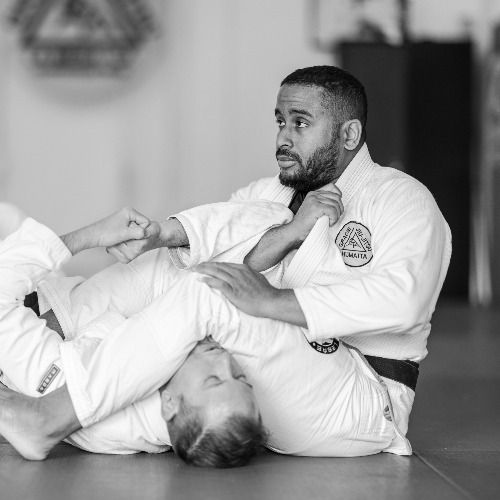
In this episode, David Figueroa-Martinez explores the often-overlooked aspect of Brazilian Jiu-Jitsu: its ability to let adults "be a kid again." Between the heavy responsibilities of work, family, and society, most adults lose touch with physical play. David breaks down why grappling is essentially "structured play disguised as combat" and how embracing curiosity and silliness on the mats leads to a healthier, more balanced life.
3 Key Takeaways
- Play as a Stress Reliever: Engaging in physical play like Jiu-Jitsu allows adults to step away from societal stressors and responsibilities, providing a mental "reset" similar to how children process trauma through play.
- The Power of Curiosity: Approaching training with "childlike wonder"—even when you are being submitted—allows for better learning and a more enjoyable experience than a purely competitive mindset.
- Male Bonding Through Tussling: For many men, the physical nature of grappling acts as a vital form of social bonding and "play" that is often restricted by modern social norms.
Chapters
- 0:00 – Introduction: Why adults stop playing.
- 2:15 – The nature of play in animals and children.
- 4:30 – Physicality: The missing ingredient in adult life.
- 6:15 – Structured play disguised as combat.
- 8:45 – Breaking social norms and personal space.
- 10:30 – The "Magic Trick": Curiosity vs. Jadedness.
- 13:15 – Finding joy in being "rolled up."
- 15:00 – The "Dirty" Wrist Lock & The Hi-man Sweep.
- 18:30 – The Dummy Sweep: Why it’s okay to laugh.
- 21:00 – Competitive prep with a playful heart.
- 23:45 – Closing thoughts: Accepting failure as part of the fun.
Are You You New To The Podcast? Start Here!
Stay Connected
DFM Coaching
For remote coaching, seminars, mindset tools, and more:
Join the FREE Skool DFM Coaching Community.
DFM Coaching | Bjj Blog
Long-form storytelling, deep strategy, and the philosophy behind the fight:
BJJ Mental Models Support
I'm proud to be an official affiliate of BJJ Mental Models—a deep resource library of conceptual Jiu-Jitsu that has helped thousands of grapplers simplify their learning.
Use my link to explore their premium offerings and support the show:
(Code: FIGUEROAMARTINEZ)
Support the Mission
If you found this episode valuable, please share it with a teammate, repost it to your story, or leave a quick review where ever you listen.
That’s how we grow and keep the signal strong.
Stay tapped in.
Thank you,
David Figueroa-Martinez
Founder, DFM Coaching Bjj
DFM Coaching Bjj is dedicated to helping you overcome mental hurdles and achieve your full potential in BJJ. Whether through in-person instruction, seminars, private lessons, remote coaching, or video analysis, I provide personalized support tailored to your needs. Keep pushing forward, and let’s grow together!
Mentioned in this episode:
Patreon Blueprint Ad
Transcript
[0:00] Welcome to Tapped In. My name is David Figueroa Martinez of DFM Coaching, and today we're going to be discussing how Jiu-Jitsu lets us be a kid again or play like a kid again. One of the things that happens when you become an adult with various responsibilities—from work, kids, to taking care of family members, multiple jobs—is the fact that we get further and further away from play.
[0:38] We get further and further away from doing physical activities. And if you look around, many of the people in your circle outside of Jiu-Jitsu, that is, oftentimes do very little physically, do very little playing physically. They are, unfortunately, tied so deeply into the responsibilities of being an adult, being a productive member of society, of being the head of a household, a parent, that we don't get to play as much as we should.
[1:13] We put everything else and everyone else forward and ahead of us as a priority, and by the time we get to any amount of time for ourselves, we're just so exhausted we don't have time for it. We would much rather just sit, veg, watch a movie, watch a TV show, nap, go to sleep, and then repeat it the next day. Now, this is not an episode where I'm casting judgment; this is just the reality for many of us.
[1:47] Those of us who have made physical activity a priority, like Jiu-Jitsu or anything like it—any grappling arts, anything that allows us to be physical with other people—we get the benefit of that activity allowing us to be childlike. And I personally think that allows us to grow and to have a really healthy view of life and time because it allows us to be more like the kids at one point.
[2:23] When you watch any nature show, whether it's the monkeys, the great apes, the lions, whatever, they're all—when you watch the kids—they're all toying and playing and grappling and tussling and moving around, and they're expending energy, and there's this playfulness that is such a benefit to their existence. When you watch your own kids, they do much of the same thing.
[2:59] And it's a huge blessing to have that moment where nothing else matters. We get to play for this amount of time, and we just get to enjoy it. We're so far in the moment because of that play that a lot of those stressors for adults go away. When you watch your own kids play, no matter what the kid is going through, they find a moment of play that kind of relieves that stress.
[3:32] They can be ailing, they could be in a hospital, they could be going through something traumatic, and at some point, most kids will find a moment where there's a level of play that they get to kind of forget about everything else. Then, unfortunately, as we get older, we get further and further away from that. Some of us play video games, and that does similar things with the exception of the really physical aspect.
[4:05] I personally think that the physical aspect is a huge and a massive important ingredient in play that more of us need. Men specifically, are just—we love tussling. My brother and I, for example—my brother does not train—he's a few years younger than me, and every time we get together we tussle at some point.
[4:38] It's usually at the end of our get-together; we dap up, we hug, and then we start like tussling for underhooks and body locks. He doesn't know what the fuck he's doing, but he understands play. He understands tussling and wrestling around. So we wrestle around a little bit and he tries to do some stuff and I do some stuff, and it's the thing that we do. It's our little male bonding moment before saying goodbye.
[5:11] And there's a joy in that. There's a joy in having that ability to be kids again. In essence, that's what our childhood looked like. We would tussle, we would wrestle around, we would play WWE, WWF, and that was our moment. One of the things—so what it looks like on the mats—it's structured play that's disguised as combat.
[5:45] Yes, it's a combat art, and it requires us to be really safe, really mindful of safety because some of the things that we're doing are dangerous. But at the end of the day, it's play. It's human chess without taking turns. It's a game with a moving, adjusting, ever-changing puzzle. It's us deciding how serious or how silly we want to be during play.
[6:19] It allows us to move freely and just experiment with our physical nature against someone else. Again, in the moment, nothing else matters when we're tussling, we're rolling around on the mat. You don't have to worry about the social norms of being good, like you get to be rough. You get to be with all, with good measure obviously. You don't want to hurt the other person.
[6:52] But so many of us are in this buttoned-up environment where obviously you can't tussle with people at work. You can't wrestle people in the office or in the storehouse or in a warehouse or a call center, any of these things. Here, you get to pull off those social norms of personal space, of not touching, of not grabbing, and here you get to really just eliminate those rules and be something different.
[7:29] You get to rediscover the joy of just messing around and failing and retrying and laughing at one another and ribbing each other. There's a sense of curiosity that happens on the mats that we often don't get outside as adults. If you can picture the kid in you or maybe the kid that you have, your child, and they see a form of magic for the first time.
[8:03] Whether you stole their nose or you made a quarter appear from behind their ear or some other weird—like you made your finger disappear—or some other card trick. Those moments don't appear all that often when you're an adult because you've become hip to the things that are going on and you can no longer suspend your disbelief or your trust in a process. We're jaded sometimes.
[8:35] Jiu-Jitsu is one of those few moments where I get to roll with someone and they do something really tricky or smooth or I had never seen. I'm almost 15 years in and there's still moments where someone will hit me with a choke that I had never seen, or for some reason in the moment I thought they were grabbing one lapel and they actually grabbed the other and then they got the choke in.
[9:06] Or they have this unique way of—like I was in open mat on Saturday and Carlos from Five Peaks twisted me up in a way that I had never seen before. I asked him questions about it later and he was like, "Dude, I don't even remember how I did that.". Those moments of actual wonder, the curiosity behind—I just got rolled up. It's bad for me; I just got rolled up. I didn't win that thing, but I'm still curious and have this curiosity and wonder of like, how did that happen?.
[9:45] How did that thing just get pulled off without me knowing, and I'm in the middle of the exchange?. Those are the things that we get to experience when we do Jiu-Jitsu as adults that in most circles or most environments, we don't get to experience. So most adults don't get to experience that. So what it looks like when we're talking about play or childlike play is you catch yourself smiling during the middle of the roll.
[: [: [: [: [: [: [: [: [: [: [: [: [: [: [: [: [: [: [: [: